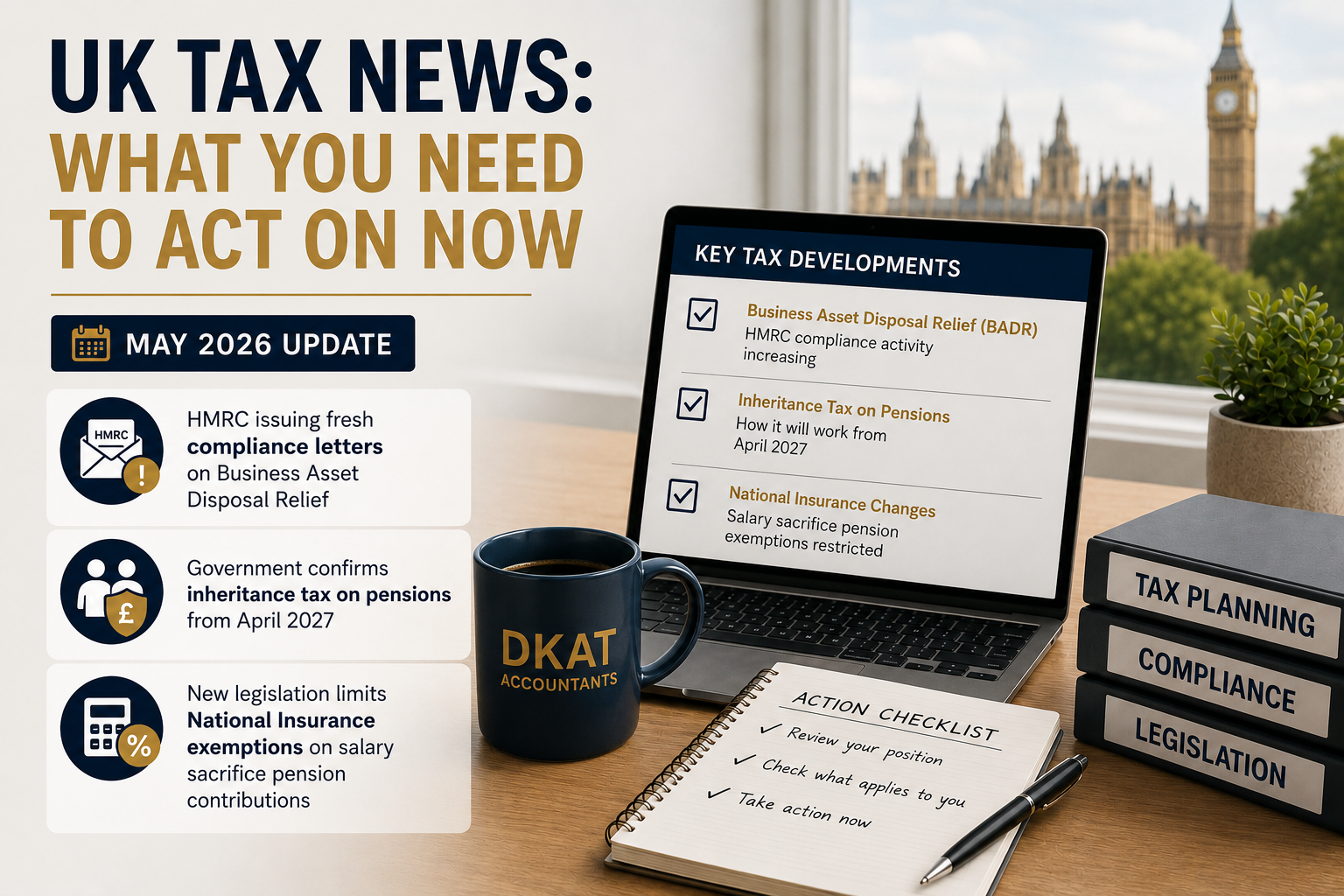
May 2026 brought several notable UK tax developments including changes affecting Business Asset Disposal Relief (BADR) rates, the phased extension of Inheritance Tax to unused defined contribution pensions from April 2027, and updates to ISA allowances and rules. Business owners and higher-rate taxpayers planning asset disposals, pension withdrawals, or ISA contributions should review how these changes affect their specific circumstances, ideally with professional advice given the technical detail involved.
May 2026 has brought a cluster of material developments across UK tax — from HMRC issuing fresh compliance letters on Business Asset Disposal Relief, to the government confirming how inheritance tax on pensions will work in practice from April 2027, to new legislation limiting National Insurance exemptions on salary sacrifice pension contributions. Here is everything that matters, verified against primary sources.
What has changed and what to act on
HMRC issuing second round of BADR compliance letters
HMRC has begun issuing a second tranche of compliance letters to taxpayers who claimed Business Asset Disposal Relief (BADR) in their self-assessment return for the 2024/25 tax year and may have exceeded the £1 million lifetime limit. This follows an earlier first tranche issued in late 2025/early 2026.
The letters are part of HMRC’s one-to-many compliance campaign. They do not constitute a formal enquiry under Section 9A of the Taxes Management Act 1970, but they are a precursor to one if the taxpayer does not respond. HMRC’s position is that the lifetime limit is £1 million of qualifying gains — after which BADR ceases to apply and gains are taxed at the standard CGT rates (currently 18% or 24%).
Who is affected: anyone who has claimed BADR across multiple disposals — the sale of a business, shares in a personal company, or qualifying business assets — and whose cumulative qualifying gains since 6 April 2008 (when BADR replaced Entrepreneurs’ Relief) are approaching or exceed £1 million.
HMRC confirms pension IHT rules for April 2027 — maximum effective rate 67%
On 11 May 2026, HMRC published a policy paper and technical note providing detailed confirmation of how the inheritance tax rules on pensions will operate when they take effect from 6 April 2027. This follows the original announcement in the October 2024 Autumn Budget and its subsequent inclusion in Finance Act 2026.
The key confirmation: where both income tax and inheritance tax apply to unspent pension benefits on death, the portion of the benefits corresponding to the IHT (and interest) paid is excluded from the beneficiary’s taxable income, regardless of how the IHT is paid. HMRC has confirmed that this exclusion applies in all cases, meaning the maximum combined effective tax rate is capped as follows:
- If a pension pot of £100 is subject to 40% IHT, £40 IHT is paid and £60 remains
- The £60 is then fully subject to income tax in the hands of the beneficiary
- For an additional-rate taxpayer beneficiary paying 45%, income tax on £60 = £27
- Total effective tax: £67 on £100 of pension benefits — a 67% combined rate
The practical implication is significant for anyone with a large defined contribution pension. Pensions were previously outside the estate for IHT purposes — they were the most tax-efficient way to pass wealth to the next generation. From April 2027, that advantage is substantially eroded.
NIC exemption cap on salary sacrifice pension contributions: Act receives Royal Assent
The National Insurance Contributions (Employer Pensions Contributions) Act 2026 received Royal Assent on 29 April 2026. The Act gives HM Treasury the power to make regulations introducing a £2,000 annual cap on the National Insurance Contributions exemption for employer pension contributions made via salary sacrifice arrangements.
The cap is not yet in effect — it requires secondary legislation (regulations) which the government has said will be consulted on before implementation. The current expected effective date is April 2029. However, the primary legislation is now enacted, making it a certainty rather than a proposal.
Currently, employer pension contributions made via salary sacrifice attract no employer NIC at all — saving employers 15% on the value of contributions above the secondary threshold. The cap will limit this saving to contributions of up to £2,000 per employee per year. For high earners with large salary sacrifice pension arrangements, the additional employer NIC cost could be material.
Mandatory tax adviser registration: three-month window opens 18 May 2026
HMRC’s new mandatory registration scheme for tax advisers who interact with HMRC on behalf of clients is expected to open its three-month initial registration period on 18 May 2026, subject to publication of the confirming statutory instrument. Tax advisers who submit returns, correspond with HMRC, or act as agent for clients will be required to register.
This scheme follows the granting of stronger HMRC powers to tackle non-compliant tax advisers from 1 April 2026. These powers — published in the Finance Act 2026 — allow HMRC to investigate and penalise advisers for “sanctionable conduct”, meaning intentionally helping clients pay less tax than they owe. HMRC can also publish information about misconduct by an adviser in certain circumstances.
DKAT is FCCA qualified and regulated by the Association of Chartered Certified Accountants (ACCA). Our registration under the new scheme will be completed during the initial window. If you are considering changing your accountant, confirming their registration status under the new scheme from July 2026 onwards will be an important due diligence step.
VCT income tax relief cut from 30% to 20% — in force from 6 April 2026
From 6 April 2026, the income tax relief available on subscriptions to Venture Capital Trusts (VCTs) has been reduced from 30% to 20%. The annual investment limit (£200,000) and the minimum five-year holding period remain unchanged, as does the income tax relief on dividends from qualifying VCTs and the CGT exemption on disposal.
VCTs are government-approved vehicles that invest in small, high-risk UK companies. The reduction in upfront income tax relief makes them a less attractive investment on paper — a £100,000 VCT subscription now provides £20,000 of income tax relief rather than £30,000. However, the ongoing tax benefits (dividend and CGT exemption) remain and VCTs continue to be a useful tool for higher earners looking to reduce their income tax bill.
The reduction brings VCT relief in line with EIS relief (which was also reduced to 20% following the same announcement). Carried interest has also been restructured from April 2026 — it is now subject to income tax and National Insurance Contributions rather than Capital Gains Tax, producing an effective rate of 34.075% for additional rate taxpayers.
HMRC warns: AI-generated tax returns causing late filings and errors
HMRC has issued a warning following a growing trend of late VAT return submissions and tax errors caused by taxpayers relying on AI tools and third-party websites for tax filing advice and calculations. HMRC has confirmed that incorrect advice from AI is not a reasonable excuse for late or inaccurate returns.
In one First-tier Tribunal case decided this month — Omar Rafique v HMRC [2026] TC09874 — a taxpayer’s application to reinstate a struck-out VAT appeal was refused in part because the taxpayer had repeatedly submitted AI-generated correspondence to the Tribunal that failed to engage with the substantive legal issues. The Tribunal was critical of the reliance on AI-generated text for legal proceedings.
HMRC has also reminded agents and taxpayers that VAT return deadlines are not extended for weekends or bank holidays. The due date is the due date regardless of when it falls — a point that incorrectly programmed or outdated third-party tools have been getting wrong, resulting in late filing penalties.
Cash ISA limit to be cut to £12,000 for under-65s from April 2027
The government has confirmed that the annual cash ISA subscription limit for individuals under the age of 65 will be reduced from £20,000 to £12,000 from 6 April 2027. The overall adult ISA limit of £20,000 is unchanged — so under-65s will still be able to invest up to £20,000 per year in a Stocks and Shares ISA (or a combination), but the cash-only portion is capped at £12,000.
Those aged 65 and over retain the full £20,000 cash ISA allowance. The rationale given by HM Treasury is to direct younger savers towards long-term investment rather than cash savings, with the aim of increasing retail investment in the UK economy. A consultation on a new simpler first-time buyer ISA product is expected in late 2026; once available, this will replace the existing Lifetime ISA.
For the current 2025/26 tax year (which closed 5 April 2026): the full £20,000 ISA allowance was available in cash. For 2026/27 (running now, to 5 April 2027): the full £20,000 remains available. The £12,000 cash limit applies from April 2027 onwards.
Summary: key dates and actions
| Date | Development | Action |
|---|---|---|
| Now | HMRC BADR compliance letters (second tranche) | Review cumulative BADR claims; contact DKAT if you receive a letter |
| 11 May 2026 | HMRC pension IHT technical note published | Review pension nomination, drawdown strategy and estate plan before April 2027 |
| 18 May 2026 | Tax adviser registration window expected to open | Confirm your accountant will be registered from July 2026 |
| 6 April 2026 (done) | VCT income tax relief cut 30% → 20%; carried interest restructured | Review investment strategy if you hold or plan to invest in VCTs |
| 29 April 2026 (done) | NIC (Employer Pensions Contributions) Act 2026 Royal Assent | Model impact of £2,000 NIC salary sacrifice cap for April 2029 |
| 6 April 2027 | IHT on pension pots takes effect; cash ISA limit → £12,000 (under 65s) | Act within the planning window — speak to DKAT now |
| April 2029 | £2,000 NIC exemption cap on salary sacrifice pension contributions | Model future employer NIC cost on high-earner remuneration packages |
FAQ Frequently asked questions
Business Asset Disposal Relief (BADR) rates have been rising in stages: 14% from October 2024 and 18% from April 2025, up from the original 10%. This still offers a significant discount versus the standard 18%/24% Capital Gains Tax rates for qualifying business disposals, but the advantage has narrowed considerably from previous years.
From 6 April 2027, unused defined contribution pension funds will be brought within the scope of Inheritance Tax for the first time, following Finance Act 2026. This is a major change from previous rules, where pensions typically fell outside the estate for IHT purposes, and anyone with substantial pension savings should review their estate planning well ahead of this date.
ISA allowances and specific product rules are reviewed periodically by the government. Always check the current annual ISA allowance and any changes to Lifetime ISA, Cash ISA or Stocks and Shares ISA rules on GOV.UK, as these can change between tax years and affect how much you can shelter from tax.
This depends heavily on individual circumstances, including your health, other assets, and intended beneficiaries. The changes create a genuine planning question for many people with larger pension pots, and professional advice is strongly recommended before making irreversible withdrawal decisions purely in response to the IHT changes.
HMRC and GOV.UK publish current rates, thresholds and allowances, updated whenever legislation changes are confirmed. Given how frequently rates can shift between announcements and implementation, always verify against the live GOV.UK guidance or with a qualified accountant before relying on any single source.
Questions about how any of these changes affect you?
Whether it is a BADR compliance letter, your pension and IHT position, a salary sacrifice structure, or how the VCT changes affect your investment planning — DKAT’s FCCA-qualified advisors can review your specific circumstances and give you a clear, actionable plan. The consultation is free and there is no obligation.
Book Your Free Consultation →Important notice: This article is based on information published by HMRC, ICAEW, KPMG, the Chartered Institute of Taxation and other authoritative sources current at 15 May 2026. All tax law, rates and legislative references are correct at the date of writing and are subject to change. The pension IHT calculations are illustrative examples based on HMRC’s published technical note of 11 May 2026 and assume specific taxpayer circumstances — individual outcomes will vary. The NIC salary sacrifice cap requires secondary legislation and the £2,000 figure and April 2029 implementation date are subject to consultation and may change. This article is for general information and educational purposes only and does not constitute tax, legal or financial advice. Always seek professional advice before taking action on any matter discussed here. DKAT Accountants is regulated by the Association of Chartered Certified Accountants (ACCA). This article does not constitute a financial promotion.